
HUMLEBÆKGAARD
Building resilience from the ground up
Near Køge · Denmark
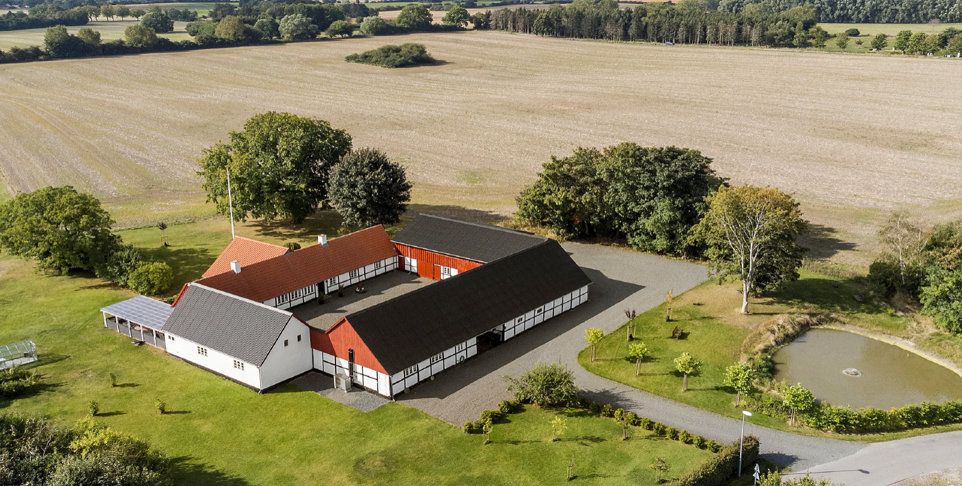
Humlebækgaard is a newly established farm near Køge, Denmark, where agricultural production, ecological restoration and community are being developed together from the outset. Rather than adapting an established farming system, the people involved have the opportunity to shape the farm around organic principles, diverse production and long-term resilience from an early stage.
The emerging farm brings together vegetable production, agroforestry, forestry and livestock, while also developing its role as a place for events and learning. Direct marketing and strong connections with the surrounding community form another important part of the concept, linking food production with local consumers and creating a foundation for the farm’s economic and social development.
Farm at a Glance

Location
Near Køge, Denmark

Farm Size
22 ha

Farming System
Developing organic mixed farm

Production
Vegetables, agroforestry, forestry & livestock

Conditions
Dry periods, changing rainfall patterns & water availability

Focus
Water management & landscape design

More Than a Working Farm
Humlebækgaard is developing as more than a place of agricultural production. From its earliest stages, the farm brings together different enterprises, people and activities, creating a setting where farming, community and learning can develop alongside one another.

A FARM IN DEVELOPMENT
Humlebækgaard offers the opportunity to integrate resilient practices into the farm as it takes shape, allowing production, landscape management and Nature-Based Solutions to develop together from an early stage.

COLLABORATIVE FARMING
Different businesses and initiatives operate within the wider farm concept, with a deliberate focus on finding synergies between them and building a socially resilient farming system.

LEARNING & COMMUNITY
Events, workshops and plans for a learning centre connect the farm with farmers, organisations and the surrounding community. Interest has already led to events and workshops during the farm's first months of development.
Farming in Practice
Humlebækgaard is developing a diverse farming system in which different forms of production and land use are intended to complement one another. Vegetable growing, agroforestry, forestry and livestock form part of the emerging farm structure, while direct sales create a close connection between production and the surrounding community.

Vegetable Production
Vegetable growing is one of the first production activities to be established at Humlebækgaard. A small no-dig market garden close to the farmhouse provides an opportunity to begin production while prioritising soil health, water retention and early revenue for the developing farm.

Agroforestry & Forestry
Agroforestry and forestry form part of the wider vision for the farm, integrating woody vegetation into a more diverse landscape and creating opportunities to combine agricultural production with ecological functions.
Livestock & Mixed Farming
Livestock production adds another element to Humlebækgaard’s emerging mixed farming system. Together with crop production and woody landscape elements, it contributes to the farm’s aim of developing several complementary activities rather than relying on a single production branch.
Challenges for a Resilient Future
As Humlebækgaard develops, changing weather patterns are already an important consideration in how the farm and its landscape are designed. Longer dry periods and heavier rainfall create contrasting challenges, making it important to retain water when it is available, use it efficiently and consider natural water flows as part of the farm’s development.
DRY PERIODS
Longer dry periods can put pressure on agricultural production and increase the importance of reliable water availability. Building greater capacity to collect and retain water can help the developing farm become less vulnerable when rainfall is limited.
HEAVY RAINFALL
More intense rainfall creates the opposite challenge: water needs to be managed within the landscape rather than simply draining away. Restoring natural water structures can help retain rainfall while reducing the loss of water and nutrients from the farm.
BUILDING FOR RESILIENCE
Because Humlebækgaard is still taking shape, resilience can be considered from the beginning. Decisions about production areas, water management and landscape structures can be developed together rather than introduced only in response to problems later on.
Together, these challenges make water a central element in the development of Humlebækgaard. The aim is not only to secure water for agricultural production, but to design a landscape that can capture, retain and make better use of rainfall while supporting healthy soils and ecological restoration.
For Humlebækgaard, building resilience means working with water from the very beginning.
ReFarm Focus
From challenges to farm-specific solutions
Based on the farm’s individual conditions and resilience challenges, ReFarm explores a combination of measures designed to improve water management, protect vulnerable soils and strengthen the agricultural landscape.
As Humlebækgaard develops, Nature-Based Solutions can be integrated into the farm from an early stage rather than added to an established system later. The ReFarm approach therefore combines measures that support productive farming, responsible water use and landscape restoration, helping to build ecological and economic resilience as the farm takes shape.

No-Dig Market Garden
IMPLEMENTED
Starting small with healthy soils
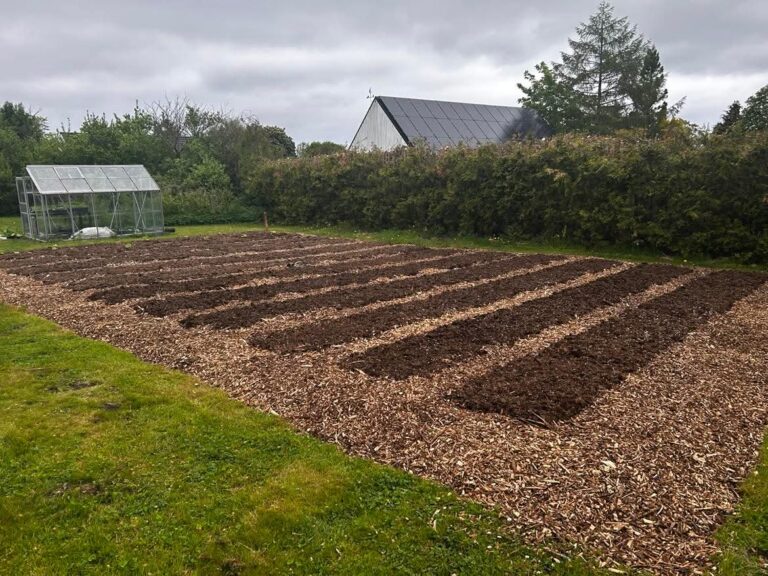
A 150 m² no-dig market garden has been established close to the farmhouse as one of Humlebækgaard’s first production areas. The system uses layered beds rather than conventional soil cultivation, with cardboard and compost-based material used to establish the growing area while minimising soil disturbance.
Beyond producing vegetables, the market garden has an important role in the farm’s early development: it can generate revenue before larger areas come into production while creating a system focused on soil health and water retention.
EXPECTED BENEFITS
Early revenue · Soil health · Water retention · Productive growing space

Rainwater Collection
PLANNED
Capturing water for productive use
Humlebækgaard plans to collect rainwater from the roofs of its farm buildings and store it in tanks for use in agricultural production. This will allow rainfall that would otherwise leave the site to become a practical resource for the developing farm.
By increasing access to locally collected water, the system is intended to reduce external water use and costs while providing greater resilience during dry periods.
EXPECTED BENEFITS
Water availability · Reduced water use · Cost savings · Drought resilience

Landscape Water Restoration
INITIATED
Keeping water within the landscape
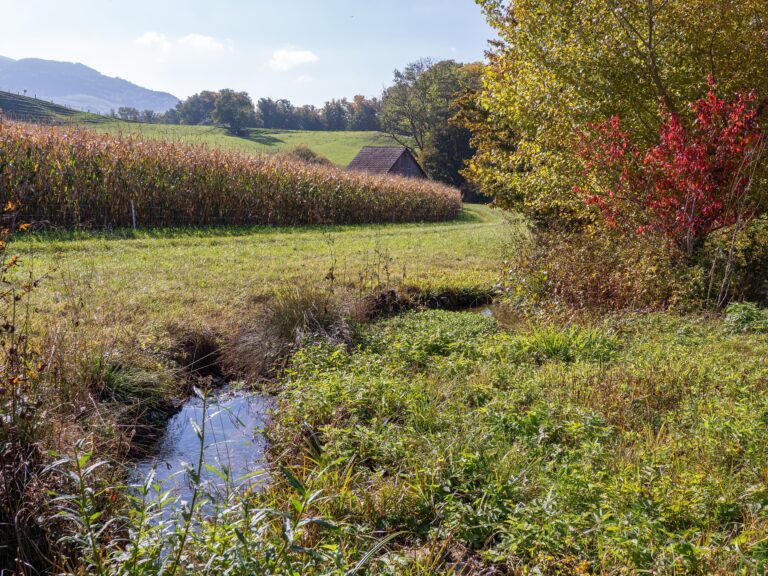
At landscape level, Humlebækgaard is exploring the restoration of natural water sources and structures as part of the farm’s longer-term development. Rather than focusing only on storing water for production, this approach considers how water moves through and remains within the wider landscape.
Restoring these natural water functions can help retain rainfall, support ecological restoration and reduce nutrient losses to the local watercourse, creating benefits for both the farm and its surrounding environment.
EXPECTED BENEFITS
Water retention · Ecological restoration · Reduced nutrient loss · Landscape resilience
From Plan to Practice
Nature-Based Solutions take different paths from idea to implementation. Each ReFarm Lighthouse Farm starts from its own conditions, experiences and stage of development. By following one selected measure in more detail, we can see how farm-specific solutions move into practice and continue to develop through experience, adaptation and monitoring.
NO-DIG MARKET GARDEN IN PRACTICE
At Humlebækgaard, the no-dig market garden shows how a relatively small intervention can become part of the development of a new farm. Established close to the farmhouse, the 150 m² growing area is designed to generate early production while building soil health and improving water retention from the outset.
01
PLANNING
Designing a productive space on a small footprint
The market garden was planned as one of the farm’s first production areas, creating an opportunity to generate early revenue before larger parts of the farm come into production. Its compact design consists of 12 growing beds, with narrow pathways and working areas arranged for intensive vegetable production.
150 m² · 12 growing beds
02
BUILDING THE SOIL
Establishing the garden without conventional cultivation
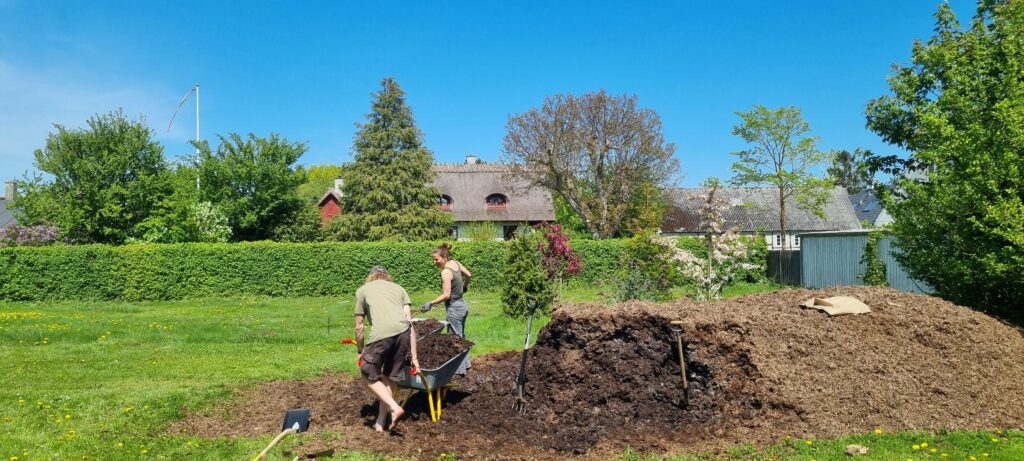
Rather than cultivating the existing lawn, the beds were created using a no-dig approach. After broadforking, discarded cardboard was used as a covering layer and the growing beds were topped with 15 cm of champost, while woodchips were added to the pathways.
Cardboard · Organic growing material · Woodchip pathways
03
IMPLEMENTING
Turning the design into a working garden
The market garden was established in May 2026, with implementation documented on 11 and 18 May. Around 100 hours of work went into planning, sourcing materials, preparing the structure and establishing the beds, turning an area of existing lawn into one of Humlebækgaard’s first productive spaces.
Implemented May 2026 · ~100 hours to establish
04
GROWING WITH PURPOSE
Connecting production with soil and water resilience
Management of the garden now focuses on achieving high yields from a relatively small area while continually adding organic material to build the soil. Increasing soil organic matter and using mulch are intended to improve water infiltration and retention, reduce water demand and store more carbon in the soil. Intensive production on a smaller footprint can also leave more land available for nature restoration.
High yields · Healthier soils · Better water retention
Monitoring & Learning
As Humlebækgaard develops, monitoring provides an opportunity to learn alongside the farm itself. By establishing baseline conditions and following selected indicators over time, the farm can assess how its Nature-Based Solutions contribute to productive farming, resource efficiency and greater resilience.
Depending on the measure, this includes tracking yields and revenue, soil organic matter and water infiltration, water collection and use, as well as changes within the wider landscape. For the no-dig market garden, the first year provides a baseline for future comparison, with surrounding lawn areas offering an additional reference for assessing changes in soil conditions.

Production

Soil Health

Water

Landscape
Learning Beyond the Farm
From local experience to shared knowledge
Humlebækgaard is developing not only as a productive farm, but also as a place for learning, demonstration and exchange. Events and workshops have already formed part of the farm’s activities, alongside the establishment of a demonstration plot for synthropic agriculture, with interest coming from farmers, organisations and companies. The longer-term vision also includes using the farm as a learning centre.
As a ReFarm Lighthouse Farm, Humlebækgaard offers the opportunity to follow resilience-building from an unusually early stage. Its experiences with no-dig vegetable production, water management and landscape restoration can show how Nature-Based Solutions are considered alongside production and business development as a new farming system takes shape.
By sharing this process, Humlebækgaard can help turn its own development into practical learning for farmers and other stakeholders exploring more resilient approaches to agriculture.